
 Iodine is an essential mineral. It has a number of essential functions in your body, including thyroid balance. Here in the west, we are suffering from an epidemic of thyroid deficiency.
Dr. David Brownstein has written an entire book about iodine. It’s called Iodine: Why You Need It and Why You Can’t Live without It. He estimates that about a third of the world’s population – 1.5 billion people – live in an area of iodine deficiency as defined by the World Health Organization.
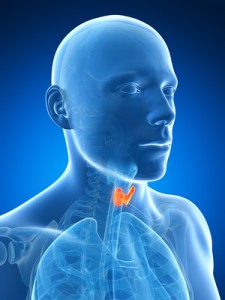
Iodine is a super important mineral in your body. It has a number of major functions. Most notable is that it is part of the thyroid hormone. Your thyroid is a butterfly-shaped gland that lives in your neck. It’s responsible for the metabolic rate of the entire body; every cell in your body is controlled metabolically by the thyroid gland.
We call the thyroid hormones T-3 and T-4 for short. T-3 has three iodine molecules, and T-4 has four. If you are deficient in iodine, you cannot make sufficient thyroid hormone.
Iodine has been the subject of a great controversy. There are people who say, ‘No, don’t take extra iodine,’ and others who say, ‘Yes, you must take extra iodine.’ There’s a lot of controversy.
I attended a lecture at a conference by Dr. Jay Mead, an MD. He termed it ‘iodophobia’ – fear of iodine. There’s a lot of that going around because of some pretty poorly done studies that he says were not scientific at all.
In this post, I will go through some of the functions of iodine, some of the foods it’s found in, and some of the diseases that it’s been known to help to reverse or bring into control.
And, of course, you need to make a decision for yourself as to whether supplementing with iodine or eating iodine-rich foods is in your best interest. I would venture to say that it is, and there are a few circumstances when it may not be. We’ll also talk about the tests that you can do to determine if you are sufficient in iodine and what you can do if you aren’t.
I’ve been on a thyroid hormone kick because I just recently completed teaching the thyroid module to my year-long Energy Recharge coaching program members and my health practitioner-level certification program for those who want to incorporate alternative methods – nutrition, diet, lifestyle – into their practices and help people really get a deep healing.
Iodine has a number of therapeutic actions in addition to being an integral part of thyroid hormone.
- One is antibacterial. You may have experience with this, in terms of topical, antiseptic-type applications where you can paint iodine over an area in order to help the body to fight off whatever bacteria on the skin may want to get into that open wound.
- Iodine treatment has also been used in water, like if you’re out going camping. Before the advent of really cool filters that are portable that you can take along with you, there was the use of iodine in the drinking water. So you’d go camping. You’d gather water from the stream, you’d put one of these iodine tablets in there. It would dissolve. It really did not do anything good for the taste of the water, but you knew you were protected from whatever bacteria critters were growing in that stream so that you didn’t take them into your body. So it’s definitely an antibacterial.
- It’s also considered to have anti-cancer properties. In particular, people with breast cancer have found really good results – and there’s a site done by David Brownstein and Guy Abraham. They’ve done a lot of research on this, so if you just Google ‘iodine and breast cancer,’ you’ll come to lots of really good resources for that.
- Women with fibrocystic breasts can actually paint the iodine on their breasts and it noticeably helps those fibrocystic breasts go down within a week. Women who have fibroids, uterine fibroids, can paint the iodine vaginally so that it gets up there. You can go in and paint it on the cervix so that it goes up into the uterus and also it can get to the ovaries that way as well, and helps with fibroids.
- The other thing that iodine is good for is an anti-parasitic and anti-viral. So it is not just antibacterial, but anti-parasitic and anti-viral. They put it in the water on camping trips because of its anti-parasitic properties.
- It also helps to break down mucus. It’s what’s called a mucolytic agent – helps to break down or thin the mucus for excretion, and it can also help to balance your pH.
Iodine has a number of important functions in the body.
Thyroid and salivary glands. There are a number of organs in the body that tend to concentrate iodine in addition to the thyroid gland, which is at the top of the list of organs that concentrate iodine: thyroid glands, salivary glands – those glands in your mouth that produce saliva to help you break down your food and moisten your food for digestion, and breast tissue – huge. Right? We just talked about how it’s used in cases of fibrocystic breasts or breast cancer.
Stomach lining. There’s also a concentration of iodine in your gastric mucosa. What does that mean? It is the lining of your stomach. The lining of your stomach is replete with iodine. So if you don’t have enough iodine, you can’t make a good gastric mucosa. You may be more subject to problems like gastritis and ulcers.
Sweat glands concentrate iodine as well. So if you’re not taking in enough iodine, you’re not going to be moistening in your sweat glands – you may not be sweating as much, which means that you’re holding toxins in your body rather than sweating them out.
The liver, the heart, and the ovaries. The ovaries actually concentrate iodine. So if you’re deficient – your ovaries don’t have enough – you can end up with cysts on your ovaries. You can be more subject to ovarian cancer.
Iodine deficiency is a real threat to your health
 So it’s really important to make sure that you get enough iodine in your system. The RDA for iodine is actually quite low, and, when we look at the amounts that people in the Western civilization take in, they’re taking in much less than the amount that’s recommend even by the RDA.
When we compare the RDA to the amount that Japanese people get, for example, – where they eat a lot of sea vegetables – they’re getting something like 13 milligrams of iodine every day. We don’t see iodine deficiencies and goiter in those regions.
On the other hand, people here in the States, where there’s very little iodine in the soil, are getting in the micrograms of iodine daily. That’s not sufficient to have excellent health, and to have excellent thyroid function.
So the deficiency is amazingly huge. And, the sad part about it is, 90 percent of what you take in gets excreted in your urine. 90 percent! If you happen to be deficient, then that percentage goes down. You are going to be holding on to more. If you take a large dose of iodine and then measure your urine, you’re going to see that you’re actually holding on to more of the iodine. So that excretion amount goes way down. That’s actually the premise for a test called the iodine loading test.
The iodine loading test will have you take a baseline level of iodine in your urine. And then you take what they call a loading dose of iodine, which would be somewhere about 50 milligrams – it’s a large dose. And you take that and you collect all your urine over the next 24 hours, and you see how much iodine is actually going out. If you’re excreting in the neighborhood of 90 percent, then you’re taking the right amount of iodine.
If you’re not excreting that much, that means that you may be deficient and supplementation with iodine would be a good thing. Iodine loading test is definitely a good test for iodine, and it’s recommended by most of the major researchers in the iodine industry, such as Guy Abraham, an MD, David Brownstein, an MD, and a number of others.
Let me give you a few startling statistics about iodine.
 655 million people worldwide have goiters. A goiter is a growth within the neck where the thyroid becomes enlarged and you see a visible lump in the person’s neck, and that has to do with iodine deficiency or iodine excess. Since iodine excess is rare, it’s mostly due to iodine deficiency. We’re looking at 655 million people that have so severe a deficiency of iodine that they’ve grown a goiter.
It affects children. Now, this is an interesting fact. Iodine deficiency, according to Dr. Mead and Dr. Brownstein, is the most common cause of preventable mental retardation and brain damage. That’s huge! If we’ve got a deficiency of a nutrient that’s correctable, why aren’t we doing something about it?
Iodine is deficient in our soils. You have to go out of your way to get enough iodine. I think it was back in the 1900s that they first started iodizing the salt because they realized that people were not getting enough iodine in their bodies. So they start putting it into salt because people eat a lot of salt.
So when the soils get that depleted of a particular mineral, one of the ways that the food supply can become replete – meaning the iodine levels become increased and replaced – is by growing foods in sea water. And there’s a growing population of people who are doing hydroponics, where they’re growing their foods in sea vegetable water…sea water, basically, which is loaded with iodine. The sea is loaded with iodine.
The edible iodine champion: sea vegetables
 So for people who naturally eat a lot of seafood, they’re getting levels of iodine that are optimal. And when I say seafood, I mean either the fish in the sea or the vegetables that grow in the sea. Did you know that there’s a whole variety of vegetation under the sea that is actually very nourishing for you? They have tons of iodine in addition to a lot of other minerals. We don’t think about eating those slimy things that grow under the sea, but, actually, when you harvest then and then dry them, they are very manageable and they’re very portable.
Because if you think about that slimy stuff that comes out of the sea, how would you package that? How would you send that? How would you purchase that? It would tend to go bad in transportation, so they dehydrate them, usually by laying them out on the beach and allowing the sun to dehydrate them, and then package them. Then you can buy them packaged and dry, some of which you can eat dry; they make a nice, crunchy snack. Others of which you would need rehydrate. So you soak them in water and then you can use them in your salads. There’s a number of amazing dishes that you can make with sea vegetables and help you get your iodine stores.
It’s estimated that you need between an ounce and two ounces of the sea vegetables in order to maintain a good, healthy iodine level. And that’s not that hard to get. We recently did a class for a group I have called the Vital Health Community. Every month we do an online video class where people come together online and watch me or a guest chef that I’ve picked out live-stream in my kitchen, and we’re actually making food. We did a class on sea vegetables. We learned to make very delicious, very beautiful dishes that are loaded with nutrients – nutrients like iodine and others that are hard to get.
Let's dig in a little bit more about iodine and the “iodiphobia.”
Why are people so scared? Well, it turns out that a lot of people think that they’re allergic to iodine. They put on an iodine-containing solution, and they get a problem. They get a skin rash, or they break out in hives or something along that line.
It’s actually, oftentimes, not the iodine itself in the preparation, but something else. If you have a reaction on your skin to iodine, then it’s worth looking at what else is in that product and making sure that you really are allergic to iodine before you shun sea vegetables from your diet and don’t take iodine.
Most people are not allergic to iodine itself. A lot of the reactions are to the radioactive iodine that is used to annihilate the thyroid gland. When the thyroid gland gets hyperactive – meaning it’s overreacting – you get jittery and agitated and your heart races, and it’s not good for you. So medicine, in its infinite wisdom and ability to ‘let’s just treat the symptom, not the cause,’ sees that as the big problem. They don’t know how to turn down the thyroid function – although, in reality, there are some natural substances you can use in high quantities – but they don’t know how to turn it down; they want to get rid of it. And so they inject people with radioactive iodine to basically destroy the thyroid gland.
A lot of people have allergies to those preparations, and I tend to agree with Dr. Mead in that I don’t think those are allergic reactions so much as just reactions to other things like the radioactivity. So that’s just an aside of the kind of bizarre way that we go about treating things rather than looking at the underlying cause. Like why is the thyroid overproducing? What kind of things can we do to help the thyroid to bring normal function back?
According to Dr. Mead in a paper called ‘Observations in Iodine Sensitivity’ in the Annals of Allergy, March 1957, iodine allergies to routine doses are essentially a myth. They did a study; they tested people who are supposedly allergic to iodine; and they did some studies to expose them to real, true iodine – iodine alone – and there were no anaphylactic reactions. So that’s why people think they’re allergic to iodine, but really it’s probably something else.
How much iodine is optimal?
 The recommended daily amount for iodine in the U.S. is considered to be about 150 micrograms. 1,000 micrograms would be one gram. Japanese take in approximately 13 milligrams of iodine a day. Our RDA in America is set to a mere 150 mcg, almost 100 times lower than what the Japanese get in their diets!
According to Dr. Brownstein, 150 micrograms is enough to barely sustain function. It’s not enough to become ideally healthy. He has case after case in his book of people who have come in with “seemingly” unrecognizable problems. They’ve had symptoms that resemble low thyroid, but their doctors have tested them and found out that, they’re not really low thyroid – maybe they’re just slightly there on the borderline. They’re on the lower end of normal. Dr. Brownstein comes to find out, upon doing an iodine loading test, that they’re severely deficient in iodine. He supplements them with the anywhere from 25 to 50 milligrams of iodine a day, and they recover. They make these miraculous recoveries.
Just because the RDA is set at a certain amount for a nutrient doesn’t mean that that’s the amount that you take for optimal health. I don’t know about you, but I don’t want marginal health. I don’t want marginal energy. I want exceptional energy. And the RDA’s are not necessarily going to get you to optimal health for lots of different nutrients. Okay? We know that for vitamin C for sure. Miracles happen when people go way beyond the RDAs for vitamin C. I think the vitamin C RDA is still at 60. They may have raised it to 100 milligrams.
We have people taking in the neighborhood of grams, multiple grams a day. We have people test themselves. I have a process I take them through for vitamin C, where they test themselves to see how much vitamin C they need. And when they take what they need, miracles happen – like longstanding allergy symptoms go away, autoimmune diseases go into remission. Their immune system steps up and the recurrent infections that they used to get no longer plague them.
So we know that for vitamin C; it’s also true for iodine.
But what’s the fear coming from? So, other than an allergy, we’re looking at issues related to goiter. There’s a lot of fear of ‘if you take too much iodine, you can get a goiter.’ And indeed you can. Again a goiter is a growth in your neck. The thyroid gland is hypertrophied – it’s enlarged – and it’s unpleasant, because you feel a hoarseness in your throat; you feel constant pain there. It can clog and make it very difficult to swallow – and very painful to swallow, and it’s just not a good thing to be happening. That can happen from too much iodine. It more likely is going to happen from too little iodine.
Where to get and how to take the iodine loading test

- The iodine loading test is easily available – Google ‘iodine loading test.’ There are a number of labs that do it. Doctor’s Data does it, Labrix does it, Hakala Research Labs do it.
- If you’re going to do the iodine loading test, get a measurement before you take the iodine loading dose.
- First thing in the morning, collect your urine, and then you pour some of it in a little vial.
- Next take a 50 milligram dose of iodine, and collect all the rest of your urine that day.
- At the end of the day you pour some of the mixture into another little vial and you send it off to the lab along with the first vial. They’re looking to see ‘what’s the difference between the amount of iodine you excrete when you haven’t taken a lot of iodine versus when you do?
You want to see if there’s a difference when you do a loading dose and what your body is handling. So that’s one way to do it. Some labs only do the post-loading, and I like to see the pre and post because it gives us a lot more information.
The other lesser known iodine-related test: halide levels
The other thing that some of the labs do is what’s called the halides. So let me give you a little background of what halides are and how important they are in your life. If you go to the periodic table of the elements – which many of you are going ‘Oh, no, that was chemistry. I didn’t like chemistry. I haven’t done that since ninth or tenth grade’ On right hand side of the chemistry chart, you’ve got helium and sodium and argon and all those kind of things going down. Next to that is a column for the halides. The fourth one down is iodine but some of the other halides in that column are fluorine, chlorine, bromine and astatine.
The environment that’s loaded with halides other than iodine, and they compete with iodine for binding sites in the body. They look similar enough to iodine that they can bind to the receptor sites. They can bind to make an analog of thyroid hormone, but it’s not real. That will trick the body into thinking that you’ve got enough iodine, but it’s actually bromine or chlorine or fluorine that’s there, and it inhibits the function of iodine and causes iodine deficiency symptoms – even if you don’t have an iodine deficiency!
The other thing that competes with iodine is radioactive iodine. So if you’re having scans done where you're being injected with radioactive iodine, or you’ve had radiation to your thyroid due to hyperthyroidism, you have radioactive iodine competing against iodine or binding sites.
If there’s a nuclear plant accident, like we had in Japan not too long ago , and it’s releasing radioactive iodine into the environment, and you're taking that in – by breathing, ingestion, or your skin, you are being exposed to radioactive iodine, which can then interfere with your own thyroid function.
So choose an iodine loading test that will also check for halides so you get a clear picture not only of how much iodine you have but how much competition is present.
Take charge by limiting your exposure to halides to improve the functional effectiveness of your iodine status.
Municipal water– And some of the places that you’re getting exposed – number one, if you drink or bathe in municipal water has been treated with chlorine to disinfect it.
Ah, what did we learn about iodine? It’s also a disinfectant. All the halides are disinfectants. Some of them have negative effects on our body; one of them has positive effects.
Tap water. if you’re drinking, bathing or taking showers in tap water, you’re exposing yourself to a lot of chlorine.
 Swimming pools. Now, personally, I like to swim, so I get exposed to chlorine when I swim. I am vigilant about not being exposed to chlorine in all my other endeavors. I purify my water, I have a whole-house filter that purifies all the water coming in and takes out the iodine and the fluoride, so then I can shower and bathe in comfort.
Then it goes through a triple filtration and reverse osmosis process before I’ll drink it. So, by the time the water gets to me, I’m drinking really pure water. If you don’t have this kind of system set up, you can do a number of things. You can get a shower filter to filter out the chlorine. You can also get either a reverse osmosis or some other purification unit for your drinking water – really important stuff.
Hot tubs. Bromine is found, in some cases, in hot tubs. It’s usually not used whole scale in swimming pools for a disinfectant, but it’s often used in hot tubs. It’s also found in bread. It’s called dough conditioner – helps the bread to be more elastic and utilize the gluten. Well, I don’t recommend eating gluten anyway, but definitely staying away from breads that have bromine in them as a dough conditioner.
 Tap water. Double whammy. In addition to chlorine, in most m,municipalities, fluoride is put in your water. That’s for preventing dental cavities, but, in fact, a lot of dentists are totally opposed to water flouridation, because it causes a condition called fluorosis, in addition to interfering with normal iodine binding.
My goal here was to just touch on the important points about iodine. So that you now know how important it is, not just for your thyroid function, but for breast health, for your female reproductive organ health, and for the entire health of your immune system.
I encourage you to check out my free SHINE program at https://drritamarie.com/SHINEINELivestream to learn more about these organs and the effects of iodine and other nutrients in those organ systems. And follow me on Facebook, Twitter, and YouTube.
Here's to your vibrant health!






You have to be careful with iodine it can cause horrible detox symptoms as it starts to detox bromine and chlorine from your system. I did not understand why i felt so horrible after taking it until i did more research. I tried smallest dose of Lugols iodine and ended up pre hypothyroid. I try to get from food sources only. It was my understanding that a goiter is caused from inflammation not a lack of iodine because of all the iodine that is in salt and other foods.
Pre hyperthyroid i meant. Radishes are also good for thyroid balance if you research. I’ve also read good things about flax and Chia, Chia contains iodine and other minerals good for thyroid function.
Hi,Dr. Rita-Marie,
Next week i have to have an MRI with contrast dye injected into me.for finding some very painful sutures left years now and got to the stage of being intolerable.
What can I take after they`ve done that to bring my body back into balance? Many regards
I also have some homeopathics
Some truly nice stuff on this site, I love
it.
My web site yellow toenails (Darnell)